Showing posts with label #saveourshipyard. Show all posts

Sunday, 24 April 2022

YES! YES! UCS: WHAT A SHOW OF WORKING-CLASS POWER!


YES! YES! UCS: WHAT A SHOW OF WORKING-CLASS POWER!

How delighted I was to be invited by the organisers - People’s Past People's Future - to their showing, in Rutherglen, of YES! YES! UCS!

What a show! What an amazing night of popular theatre. What a powerful, awe-inspiring portrayal of the power of the Scottish working class, once mobilised. And what an impact it had on the audience, overwhelmingly local working-class people.

Written by Neil Gore for Townsend Productions to celebrate the 50th anniversary of the momentous 1971-72 Upper Clyde Shipbuilders famous work-in, the production is a phenomenal combination of entertainment, education on a key chapter in labour movement history, and lesson in class power, delivered with uplifting verve by two young women actors, Janie Thomson and Heather Gourdie.

Workers Occupy the Shipyards

The theatre show is part musical, part sketches and dialogue by the two characters, interspersed by powerful speeches, peppered with humour, pathos and brilliant storytelling. It draws the audience into the whirlwind events of the workers’ occupation of the closure-threatened shipyards, solidarity conferences and general strikes, and the ultimate victory of the class power unleashed against the vicious axe-men of the remote Westminster Tory government, led by Ted Heath.

In what was an overwhelmingly (almost 95%) male workforce, the play dares - successfully - to portray events through the eyes, experiences and personal growth of the two young women characters, Aggie and Eddy, who worked in stock control and the shipyard’s drawing room.

Through dynamic dialogue and song - backed up by vivid poster art, animation, real-life newsreel and recordings of powerful speeches by the likes of the workers’ main public representative, Jimmy Reid - we witness the personal growth of the two young women workers into dynamic fighters, at the same time as the play vividly recounts the mass struggles of the time: the power of the Scottish working class and their active allies across Britain and the far continents.

Personal dreams, doubts, bereavement and growth in ‘the college of knowledge’ that is the trade union movement are all skilfully, powerfully presented in a fashion that never loses the attention of the working-class audience. It is funny, moving, inspiring, and absolutely uncompromising in its socialist message.

Aggie goes from stock controller to shop steward, breaking through nervousness to become an inspiring orator, discovering the power of words to ‘light up something inside us.’ Eddy follows the advice of her dying shipyard worker father and ‘follows her dream’ to become an artist, but never loses her roots, taking up the fight for justice for workers blighted by asbestosis.
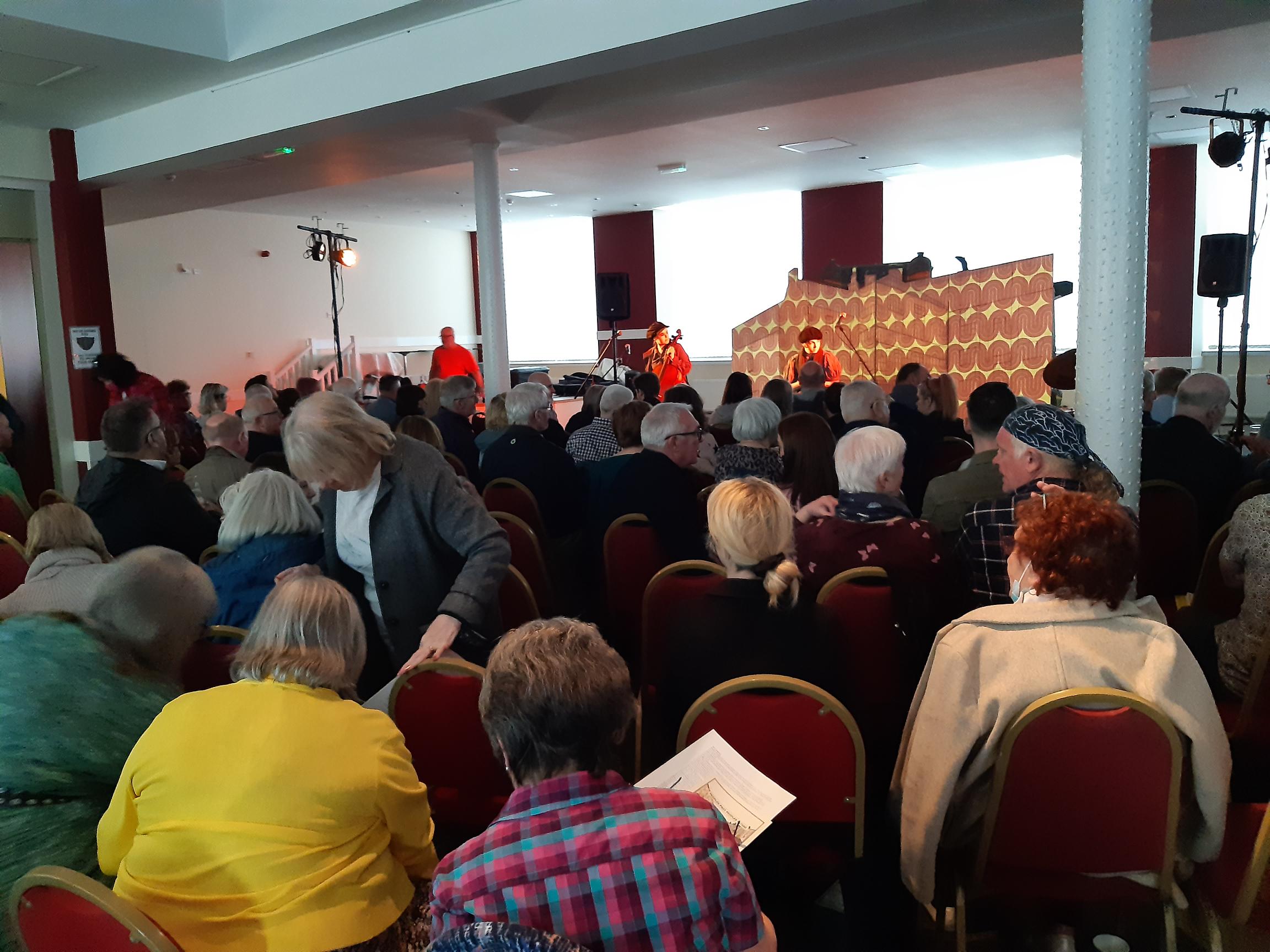
Part of the large, working-class audience in Rutherglen 


Hope Shines Eternal

And hope shines out. Hope based on this accurate account of the real victories of united workers’ struggles 50 years ago, but also hope that new, current generations will reawaken to such methods, as – in Aggie’s words – “the Tories never learn but also never forget nor forgive us.”

After an interval during which the People’s Past People Future organisers kindly laid on ‘a strikers’ supper’ of wholesome soup and rolls, the night was rounded off by songs from Rutherglen Community Choir and a powerful rendition of two of his union songs by 81-year-old socialist singer-songwriter, Arthur Johnston.

Socialism Returns!

And yet it didn’t end there! A big group of the audience – including many of the large numbers who bought my pamphlet Socialism Returns in the 21st Century, as advertised by the organisers during the raffle! – kept me back for nearly an hour discussing why we need the spirit of UCS today, or as a few of them said, “we need a revolution!”

Many of these men and women were scathing about all the political parties – “For the first time in my life I won't vote for any of them" – but readily added they trust our party, the SSP, because they know we are honest and tell it how it is on the side of the working class.

I left this brilliant night thinking: imagine if YES! YES! UCS! was shown on mainstream TV!

Imagine the impact on younger people with little or no knowledge of such glorious periods of working-class struggle. Imagine how it would uplift and embolden workers today, as they face the capitalist thuggery at P&O ferries, fire and rehire, and a multitude of daily assaults on our lives as the profiteers seek to recover and replenish their ill-gotten wealth, at the expense of terrible suffering and privation for millions of workers and their children.

Which is why those in power would not dare televise it! And why it’s so important that others imitate the actions of People's Past People's Future by taking this marvellous, inspiring piece of popular theatre into local communities: to the people with most to gain by rising up in the manner of UCS.

As John Lennon sang in response to the UCS, “Power to the People!”


READ THE BLOG & BUY THE PAMPHLET 

Last August 2021 I wrote an article on the UCS work-in, on the 50th anniversary of one of the mammoth demonstrations through Glasgow in support of the right to work. 
It cannot match the graphic portrayal of musical theatre, but it helps give background reading to the events, and lessons for today. Please have a read of it. 
You will find it here: http://richieventon.blogspot.com/2021/08/ucs-still-inspiration-50-years-on.html


And consider ordering a copy of Socialism Returns in the 21st Century - which sold in large numbers at the People's Past People's Future presentation of YES! YES! UCS! 
Order here: https://scottishsocialistparty.org/product/socialism-returns-in-the-21st-century/


Saturday, 5 October 2019

"WITH UNITY YOU CAN MOVE MOUNTAINS" - reflections on Belfast shipyard workers' victory


Thursday 3rd October, 2019, will become an important date in the history of Belfast workers' struggles, and indeed of workers well beyond the city limits.
That morning, a proud but emotional group of workers returned to work in the Harland and Wolff shipyard, nine weeks after they had faced total, permanent closure.

By seizing control of their workplace at the end of July, the 123 members of Unite and GMB trade unions prevented the devastating disappearance of this landmark workplace. They defied and defeated the owners who had run the yard into the sand; the Tory government of Boris Johnson who dismissed appeals for government intervention with the contemptuous remark "this [closure] is a commercial decision"; and the sceptics in our own trade union movement who habitually greet closures and redundancies with the refrain "there's nothing we can do to stop it." 

They fought like lions

If these brave workers hadn't taken swift, united, militant collective action, the hovering vultures would have swooped, asset-stripping, turning this shipyard, established in 1861, into yet another marina or other waterfront tourist attraction. 

Instead of caving in with whimpering resignation, these workers and their local union officials fought like lions, refused to give up their belief in the rich potential for the yard and its skills, and demanded renationalisation to build that future, highlighting especially their readiness and ability to contribute to a thriving green energy industry.

Where private capitalist ownership squandered workers' skills and the unique facilities of Europe's biggest dry dock, working men and women had a vision for the future - and fought for that dream. 

Whilst their central demand for nationalisation fell on the deaf lugs of Boris Johnson and his cabal, the nine weeks of relentless campaigning and the workers' case for a thriving future for the yard has won over a new owner, InfraStrata. Eighty of these fearless fighters returned to work on Thursday 3rd October, with confident predictions of that number rapidly growing to 400.


I spoke to Harland and Wolff's Unite shop steward, JOE PASSMORE, his first evening back at work. 

"It's been quite emotional today, Richie," said Joe, with classic understatement. "It's historic." 
I asked him where their determination to fight back came from. 

"Previous owners tried to run it into the ground, with contempt and mismanagement. There were community leaders,  including ex shipyard workers, talking to the company - going back years, we've now discovered - telling them about the possibilities and potential. But they were too aloof to listen. But we knew we had a successful industry in the making and we were not prepared to let it suffer a slow death. That's where our belief and determination came from."

Workers' Unity the Key to Victory

Their fighting spirit and determination inspired the solidarity of workers far and wide. Very significantly, the H&W workers were themselves united; not divided on sectarian lines. Nor did they allow any hard or soft border to cut across their working class unity; amongst the trade unionists who joined their solidarity rallies (usually with generous donations in hand) at the shipyard gates were strikers in Northern Ireland's civil service and health service, but also workers from Dublin and veterans of sit-ins at Waterford Glass. 


Occupation and Renationalisation

But how did they prevent closure? What lessons for workers facing similar threats - whether the Ballymena Wrightbus workers, or others across Ireland and Britain? 

Joe is keen to inform and inspire others:
"The first key to our success was how we let everyone know what was happening, with use of social media. That meant we didn't have to hold meetings every day. Our members knew everything we were doing, including the crises we faced and the brick walls we ran into. 
The next key was our use of the press to reach everyone. The first ten days especially we were headline news in every paper and TV, making sure we were in everyone's thoughts. 
Social media and the press are vehicles, but the key to it all was preparation and organisation. Even while we were in negotiations with the previous owners we set up our own Cobra Committee,  where we looked at the worst case scenario,  and planned to occupy the plant. We took on board the lessons of previous situations where they'd done this, like Visteon and even in Scotland.  

"Our intention was to lock the gates and let nobody in. But what we actually did, without pre-planning it, was that we took control of the gates, and with people we judged were good for our cause, we applauded them through the gates. Control of the yard gates was key, not locking the world out. 
"We needed the forest of flags from all different trade unions at the gate, and our visible presence. We even had Belfast tour buses being detoured to visit us, a tourist attraction, with tourists standing up waving to us! We had to be in the public eye, to get our case across."

"You Can't Buy Commitment Like That!"

I suggested the relationship between workers and their union is a critical factor in any battle. Joe told me of his pride in the workforce and the union. 

"Each time we got coverage in the press it gave our people confidence and the belief grew that we would get an outcome. We had people covering the nightshift on the gate every single night for nine weeks. They never got a penny pay for doing this, don't forget. That's an incredible level of commitment. You can't buy that. They never stopped believing. They knew where we were, even the setbacks in the campaign, and they still believed in us."

So where are they up to now, after gaining a new owner, InfraStrata? Joe explains:

"All along our vision was about saving the jobs, but by getting back inside to then relaunch the yard. "We've had nine weeks of sitting in the wind and cold, having earnest discussions about the future. We have a strong union to deal with any issues that arise. Our job is to reeducate them into leading the company from the bottom up. The guy who's taken over has promised the union, through our reps, will be part of decisions.

"The core of Infrastrata's current work is controversial, it's building gas storage facilities. But he says his long term interest is in repairs and green energy,  and that's our realm. 
And the other thing that inspires our confidence in the future is that he's looking at apprenticeships and reskilling. We didn't even have to tell him. We are skilled tradesmen, but all of a certain age. If only we can get hold of young people and teach them the skills - even enough to be semiskilled steelworkers or welders in the interim before apprentices start - that would be a huge boost. We are hopeful for the future. 
And the new owner's hopeful of 400 jobs in the yard."


Joe sees their own battle in its broader context. 

"Our situation is a microcosm of the whole UK. There's big possibilities in green energy, but to build on those opportunities we may not have the people and that's scary. 
It's contradictory when the government give the orders for green energy but haven't been responsible enough to build up the workforce, with the skills. A Labour government would face the same. We really have to look at infrastructure as well as orders. We need skilled employment to be the absolute priority before we lose it."

In another sense too, Harland and Wolff is a microcosm.
Joe explained to me how the government sets budgets and prices for green energy, "so private companies look for the cheapest possible option. Big companies cut to maintain profit, so when it gets down to small companies they won't take on work that won't make a profit. The likes of H&W just about break even. The government won't subsidise, they are trying to do it on the cheap. They don't seem to see the bigger picture and the effect of their actions, behind the political headlines." 

To me that underlines the absolutely justified central demand of these workers' campaign, for nationalisation of H&W. 
But not in isolation; as we've repeatedly written throughout this battle for survival, we need public ownership of all the shipyards and the entire energy sector (alongside transport, construction and the banks) to plan and invest in a clean, green, sustainable future, with full involvement and input to decisions by the shopfloor experts: workers like those who've just saved the Belfast shipyard. 

Replace the Orange and Green Politicians

Fighting for future generations will have been a steep learning experience for every worker involved. Amongst many other lessons, the role of Orange and Green politicians will have been exposed. 
One memorable moment in their campaign was the announcement by Unite that they would stand workers' candidates in East Belfast and elsewhere, a challenge that certainly concentrated the minds of the foot-dragging DUP politicians, who had done nothing to wield their leverage over the Tory government to pursue workers' demand for government intervention, for renationalisation to the save the shipyard. 

Speaking to me the night the victorious trade unionists had returned to work, Joe was blunt in his appraisal.  
"The politicians played little or no part. Even those we met at the TUC Congress, it was all words of sympathy, not saying what they would do for us, not one of them saying how they'd go about it. But it's action that wins struggles, not sympathy."

Writing as a socialist who grew up amidst the destructive Orange and Green politics that curses the working class in N Ireland, I hope the threat issued by Unite will grow into an anti-sectarian, united working-class challenge in elections, with worker candidates backed up by the unions and cross-community groups, taking up the class issues that unite ordinary people.
That would be another massive monument to the united victory of the Harland and Wolff workers of 2019. 


Moving Mountains!

This heroic battle, and particularly the fact it won the jobs back, has sent ripples out across workplaces. As Joe told me, "Every dispute now the first thing workers say to the union officials is should we occupy?!" 

When I asked Joe for his core message to other workers facing job losses or closures, it was the same solid, inspiring one that he has carried with him at meetings throughout the past nine weeks.

"If you have a cause and believe you are right, don't be afraid to speak out. 
"A voice among a couple of friends is great, but when everyone stands as one, united, that's real strength. That's when you get publicity, and the bigger your noise the bigger your chances of victory. 
"There's incredible strength in unity and people have to realise that with unity you can move mountains."


Thursday, 19 September 2019

CLIMATE CHANGE: A WORKERS' ISSUE


As school students and other young people spearhead global strikes and direct action against the planet-threatening climate crisis, they have appealed to workers to join them in 'a global general strike'. 

This appeal is an extremely important and welcome step forward; a glimmering of recognition by young people too young to have experienced work or trade unionism that the organised workers' movement is critical to winning meaningful action against global warming. And an important riposte to the utterly false and dangerous idea that it's older people who are to blame for the climate crisis.

As we've said before, the climate crisis is not a generational issue, it's a class issue.  

Older or middle-aged workers haven't polluted the planet. Profit-crazed capitalists have. 

For over 200 years they've plundered the planet and exploited its people for carbon, to fuel their accumulation of private profit. 
Recent reports confirm that it's the likes of BP and Shell - financed by the big banks - who are the biggest polluters. 
Another reveals the biggest 100 companies on earth account for 71% of carbon emissions. 

Trade Union Issue

As the recent TUC Congress unanimously agreed, climate is a trade union issue. The radical changes needed to tackle the impending disaster - with scientists giving us a mere 12 years to stop irreversible damage to the planet - require the active, urgent, collective action of workers. 


As the SSP has consistently argued, and TUC Congress reiterated, we need a Just Transition to fossil-free energy, not a punishing programme of job decimation and deprivation of working class communities, as some of the fringes of the environmental movement advocate. And public ownership of all forms of energy and other key sectors of the economy - including transport, housing, shipyards, and banking - is at the very heart of the solution to pollution. 


Public Ownership of Energy 

Policies adopted - unanimously - at the recent TUC Congress recognise this truth. Alongside Motions demanding that 'workers must be at the heart of delivering' a Just Transition, and a green transport system, Congress demanded public ownership of energy and the big banks. As Bakers Union general secretary, Ronnie Draper, said in proposing it:


"Public renewable power is less expensive than private, which not only faces higher interest rates and other costs, but also relies on various subsidies and long-term “power purchase agreements” in order to guarantee profits for investors.
Public ownership not only eliminates those unnecessary costs and provides cheaper power for users, but also allows us to address domestic skills deficits. Under public ownership and a planned approach, we can make use of the skills we have in the present, while we develop the new skills we need for a vibrant, thriving sector in the future."


SSP Members Active on Issue

SSP members in the unions have combined with others to maximise involvement of workers in the Youth Climate Strike week of action. For instance, both as an elected Usdaw national Executive Council member for Scotland, and SSP representative, I've collaborated with union activists in Unison, GMB, PCS, Unite and EIS to establish a Campaign Against Climate Change group in Glasgow. 

Though in its infancy, this group is working to involve workers alongside young people. We recognise that the first task is to engage with workers, explaining the issues, offering alternatives that would enhance workers' lives, rather than pose a threat to jobs and living standards. 
For example, we've discussed the win-win policy of free installation of solar energy in homes, and I advocated the council unions lobby Glasgow city council to take over the bus service being surrendered by First Group, as a baby step towards a full municipal bus service, which in turn should become part of a free public transport service to help combat car pollution. 

Alongside that we have been building for attendance at the demos and rallies on 20 September, for instance during workers' lunchtimes, or using flexitime, or days off, or where possible by clocking off to attend. Unison stewards have negotiated non-victimisation agreements with councils for members who participate.

Answering Workers' Fears 

Likewise, at the September meeting of the Usdaw Executive Council, I got the issue put on our agenda, introduced it, spelling out the key issues from a worker's perspective, and advocated concrete steps by our union - all of which were agreed, unanimously.  That includes appealing to all reps to take part in rallies if possible, encourage members whose shifts allow to join the events, and to stage workplace events where feasible - above all, starting discussions on climate change and alternatives in meetings of members.  

Crucially, we need to overcome the legitimate fears of many workers that what's on offer is the slaughter of jobs and a 'hair-shirt'  existence. That emerged in our very healthy discussion at the Usdaw EC, which our explanation of massive job creation through a Green New Deal, and trade union control of a Just Transition, convinced the entire meeting. And that's in the union primarily organising retail workers; how much more critical it is to have a package of policies to engage, convince and mobilise workers in the fossil-fuel sector, such as North Sea installations.


Class and Climate 

That's precisely where a class-based socialist alternative comes into its own. The public ownership demanded by the TUC would open up the opportunity to redeploy existing workers, reskilling where necessary, as well as a whole new green industrial strategy that could create at least 1.5 million skilled, well-paid, unionized jobs. 


The concrete example of the heroic resistance to closure being staged by the 123 Harland and Wolff shipyard workers in Belfast proves the point.  They are battling for renationalisation to include green energy production, which they've already done as their primary source of work in recent years, to help build equipment for offshore energy. 


Alongside the campaign to end the globalised capitalist lunacy of equipment for the giant £2bn NnG offshore windfarm a few miles from the Fife BiFab yards being built in cheap-labour Indonesia, and then transported 7,000 miles in diesel-belching vessels, this shows how democratic public ownership of all production and distribution of energy supplies could vastly boost jobs and wages, combat fuel poverty, and help clean up our corner of the planet for generations to come. 


System Change - to Socialism 

We urgently need system change to combat climate change. 

Change to a system of democratic public ownership, where the skills of workers are deployed to produce and distribute clean, green energy; build and retrofit homes to the highest environmental standards; offer an integrated, free public transport network that combats both poverty, social isolation and pollution; and uses the vast funds of a state bank to help finance a Green New Deal. 


The power of organised workers - alongside the energy and vision of young people - needs to be mobilised for such a clean, green, and nuclear-free, socialist Scotland. 
The SSP commits to combine with others for that future. 


Tuesday, 27 August 2019

Harland & Wolff: THE POWER OF WORKERS!


At the end of July, the iconic Harland and Wolff Belfast shipyard was declared dead by politicians and 
management alike. The 123 workers and their unions (Unite and GMB) seized the initiative, seized hold 
of the yard, and demanded “Save Our Shipyard – Renationalise Now!”.
Their courageous, decisive action and clear-cut battle-cry has mustered the active support of workers 
all over Ireland, north and south, as well the UK, USA, South Africa, and across Europe. Daily solidarity 
visits, collections for the hardship fund, and solidarity rallies and marches, have given a glimpse of the 
latent power of a united working class determined and willing to take action.

Occupied - Renationalise Now!

When the politicians – particularly the DUP, who ‘represent’ the shipyard area of East Belfast – refused 
to take meaningful action to pound the minority regime of Boris Johnson into saving the yard, its jobs 
and skills, the workers declared they will stand trade union-backed candidates against them in a 
general election.

This determined stance and collective action has not only inspired thousands of trade unionists, but 
brought the local DUP politicians to heel, and won extensions (by the administrators) of the ‘unpaid 
temporary layoff’ period to 30 September, buying time to either achieve renationalisation or get a 
serious buyer, with every existing job guaranteed.

Four weeks after the yard’s obituaries were being written, five credible bids are now being 
negotiated. That’s the potential power of collective union action, which needs to be deployed 
far more generally.

Two Futures

This battle provides a glimpse of two stark choices for the future. 
One where the government is prepared to let the whole community, jobs and skills sink to the 
bottom of the Irish Sea, because, in Johnson’s words, “this is a commercial decision.” 
Or one where the collective strength and action of workers through their unions secures 
public ownership and a whole new green industrialisation, with quality jobs for the future.

The entire trade union movement – including those gathering at the TUC in Brighton, should 
pile in with solidarity until victory for the Harland and Wolff workers – and apply its lessons 
across the board.


Joe Passmore (on right), UNITE shop steward, with Paul Beattie (GMB)


I spoke to JOE PASSMORE, Unite shop steward in Harland & Wolff, about their heroic       showdown with those who would leave an industrial desert in Belfast and call it progress!


Richie: YOU'VE TAKEN ACTION TO STOP CLOSURE OF THE SHIPYARD. WHAT WOULD 
THE IMPACT OF CLOSURE HAVE BEEN, PERSONALLY OR GENERALLY?

Joe: “The impact would have been on the wider community. Yes, it was about our 123 jobs, but 
the number of jobs generated when we get a  contract goes into the hundreds, and a few years 
back we had 1,500 working here. A lot of them local people, living in Belfast, feeding into the local 
economy. 
It would have been a catastrophic loss, and also a lot of industries feed off us. In fact a lot of jobs 
have been lost in other companies since we went into administration.
But it’s not only about jobs, Harland and Wolff is iconic in Belfast. The idea that those giant cranes 
would become a monument to the past would be heart-breaking. And aside from the emotional part, 
an economic disaster.”

RV: WHY DID YOU DECIDE TO OCCUPY THE YARD?

Joe: “We occupied because this was a set-up. The more we learn, the more we think plans to close 
this place go back years, with key players including politicians and government departments.
They sold us a dream about refitting cruise liners and gave an exclusivity clause to the company 
promising this, MJM Marine, of Newry. Two weeks before they were meant to finalise the deal, 
MJM withdrew the bid, cut it from £9m to £2m, and didn't include the workforce in their plans!
Their plan was to bring people in from abroad, on slave wages, and then get rid of them. That's
 what this company has done elsewhere.
Pulling the plug was blatant profiteering at the expense of working people.

There was intense anger at this. The union held meetings at board level with the owners, and took 
over the running of the meetings! We called in the politicians. But we also set up our very own
 "Cobra Committee", a Council of War.
We made it plain we are not going to lie down. We planned to take control and that's exactly 
what we've done, blocking off all entrances bar one. And our motto is that we only let people 
in who have our future at heart; we will not accept the vultures.

Five or six companies are starting to finalise bids this week. Why were they never in the loop before?
They were excluded because of the agenda to close the shipyard. Now they are falling over themselves 
because of the stand we've taken and the publicity it's gained. We've scared off the vultures and scared 
the living hell out of the politicians.

The DUP has the ear of the government but wasn't prepared to do anything. We were butting heads 
with them. It's only very recently they've shown any willingness to help, because we had them on the 
ropes. 
We focused their minds by announcing we would oppose them in East Belfast in a general election, 
taking away workers' votes, which would lose the seat for the DUP.”


RV: YOUR CALL FOR RENATIONALISATION HAS BEEN DYNAMITE IN LIFTING THE 
SIGHTS OF WORKERS HERE. WHY DO YOU DEMAND THAT?

Joe: “Renationalisation is the easy way to solve this. We have plenty of work we could bring in right 
now.
Before they pulled the plug, BAe packages for submarines worth about £3m were lined up to come 
to us, with all the technical stuff sorted.
Even since going into administration, enquiries about use of our docks for ship-repair work, worth 
about £1m-£1.5m, have come in. So we could already have enough work to keep us going up to 
Christmas. But we couldn’t take the work because we don’t have an owner.

The government are aware of all this, and the work it could bring in, but seem reluctant to go near 
the word nationalisation. I don't care what they call it, but it's the obvious solution.
We need to force industrial leaders to recognise the advantages of long term planning and
investment in people over short-term financial gain. the consequence for continuing on the 
present trend will be catastrophic to British industry. 
Looking at Ferguson's in Scotland, even the DUP parliamentary leader has recently said there's no 
reason why if the devolved Scottish government can nationalise, that the UK national government 
can't do so.
Now it looks like we need to rely on the big hitters to buy us.”

RV: ANOTHER SOURCE OF INSPIRATION TO MANY OF US IS YOUR CALL FOR RENEWABLE 
ENERGY PRODUCTION AT H&W. WHY?

Joe: “That has to be a big consideration. At least two of the five bidders are concentrating on 
renewable energy. The last ship we built was 2004, it's been mostly green energy production 
since. We have a history of it, and have all the prototypes. It's what we are capable of.”

Previous article in Scottish Socialist Voice 


RV: WHAT ARE YOUR MAIN MESSAGES TO TRADE UNIONISTS HERE?

Joe: “We have hit a nerve with our stance. We've found a way of fighting. We will not let anyone 
destroy our communities for short-term financial gain. 
My biggest wish of all is that other people, other workers, see something unfair, morally corrupt, 
and that they stand together, refuse to accept it. If we don't take charge, say we're not moving 
until these things are put right, the whole of industry will be destroyed.

My main message to other trade unionists: this is what you can do if you stand together.

We are 100% unionized, but it's not enough to get a membership, this is what the unions should 
be doing. Get over the defeat of the miners and other issues. We are stronger and smarter. We 
shouldn't underestimate what we can do. Several other disputes in Northern Ireland are drawing 
on this example, beginning to see the potential.”

………...
Send union donations to either Unite or GMB offices in Belfast - help sustain this very 
important struggle. 

Unite, 26-34 Antrim Rd, Belfast BT15 2AA
GMB, 1A Victoria Rd, Holywood  BT18 9BA 

Friday, 2 August 2019

September 20: WORKERS AND YOUNG PEOPLE UNITE AGAINST THE CAPITALIST POLLUTERS!


Youth climate strike, Sydney, Australia

As we live through the molten heat, thunder and lightning, floods and general climate chaos of recent weeks, new reports on the catastrophic impact of global warming highlight the urgency of action. 
And plans are in motion for the biggest global protest action so far, on 20 September, with striking school students appealing to workers to join them in 'a climate general strike'. 

A new Australian academic study warns of “a high likelihood of human civilisation coming to an end” by 2050!

Even at the less apocalyptic end of the scale, there is widespread agreement that unless the impact of relentless plundering of the planet by the likes of Shell, BP and the banking sector that finances their environmental rampages for profit is reversed, the world's poorest will suffer most – and devastatingly.

Flooding, mudslides, raging fires, homes wiped out, loss of clean water and destruction of farming land are already happening, and could be joined by escalated wars and conflict.

No wonder tens of thousands of young people have decided enough is enough; started the Fridays for Future school strikes; staged bold, eye-catching direct-action protests - and called for a global 'climate general strike' on 20 September. 

That call, that appeal to workers to join the school students’ protests, is a very welcome glimmering of recognition of the potential role and power of collective workers’ action to challenge the climate crisis. 

Harland & Wolff workers demand 'Save Our Shipyard - Renationalise Now'

Harland and Wolff Workers Inspire Others

As 20 September looms, we've had glimpses of that potential power in the land, as groups of workers and their unions take collective action on their own immediate struggles for survival. 

Probably the most dynamic display of the power that needs to be unleashed more generally - with concrete demands that point to solutions - has been the courageous and audacious action by the workers in Belfast's Harland and Wolff shipyard. 
During 1939-45 war production, 35,000 worked there! As part of the deindustrialisation and deskilling of the economy - in favour of cheap-labour, insecure, service sector jobs and fast profits - the yard has been decimated, with a mere 130 now employed there. The last time a ship was built was in 2003. And the current battle is to prevent outright closure.

Save Our Shipyard - Renationalise Now!

Under the privatised ownership of Norwegian Fred Olsen's, these highly skilled workers turned to ship repairs and construction of offshore equipment for wind turbines, oil and gas drilling. But Olsen faces bankruptcy, tried to sell H&W, convinced the workforce a buyer named Flack was the bees’ knees, until he flacked off and left the workers and their families facing closure on 30 July.

Rather than lie down in abject surrender, the workers and their unions - Unite and GMB - staged an occupation of the yard days before the administrator was due to wield the knife, and made a clear, stark demand: Save Our Shipyard - Renationalise Now!

Their fighting action and demands rallied the support of a whole array of other trade unionists and young people.

People Power: ‘Together we become Giants’


This highly visible, militant collective action - with the clear-cut call for the government to take over the yard and save the jobs and skills - won at least a short reprieve from closure.

As UNITE rep Joe Passmore said,

"This is people power, a small step, but we were due to close today if it hadn't been for our action. Not just ours, but the actions of the entire trade union movement which has responded en masse. It shows that when we shout together, somebody has to listen. When we stand together, we become giants." 


Nationalisation would allow diversification and create vastly more jobs

Climate Crisis is a Workers’ Issue

This battle highlights several critical points of general significance: the utter inability of private capitalism to secure jobs and a future for the next generation; the power of organised workers to effect change, because of their role in the economy (in contrast to pleading with remote politicians for solutions); the central role of the working class in the struggle to utterly change the system and thereby protect the environment from the rapacious destruction by profit-hunting capitalist owners, whose only concern is short-term maximisation of profit margins; and the equally pivotal solution of democratic public ownership in order to protect people and planet alike. 


Diversify to Clean Production


Harland and Wolff workers have skills they want to utilise and pass on to the next generation. They are rightly demanding nationalisation to achieve that. 
They have already diversified use of their skills to an extent, but the entirely piecemeal nature and appallingly limited (in fact, declining) rate of investment by governments and big business in clean, renewable energy means the potential for the yard in these fields has been totally untapped, leaving workers looking into the abyss.

They are demanding some of the substantial Royal Navy contracts should go to Belfast, and their decisive action could embarrass Johnson into conceding that. In itself that would be a victory for collective union action - and would buy time to campaign for urgent diversification of production into the likes of marine engineering for offshore energy production, as part of a publicly owned green energy industry. 


Scotland's offshore energy could be a massive source of jobs - if publicly owned


BiFab & the Caley - Cases for Public Ownership


Meantime in Scotland, two groups of workers face devastation that could easily be averted, and transformed into secure, expanded, socially useful production, if the Scottish government had the political ideology and will to take them into public ownership: the BiFab yards in Methil and Burntisland, and the Caley railway workshop in Springburn. 

 
Rally at the Caley - 163 years of tradition wiped out


Workers were in tears of rage and sadness as they rallied at the Caley on the day it shut down, after 163 years of rail manufacturing. That is industrial vandalism, by the capitalist owners since privatisation, and by the SNP government who spurned the unions' calls for nationalisation. 
It could be an integral part of a public rail and transport network, building and repairing rolling stock for a vastly expanded and improved rail service. 
And as the SSP has pioneered and fought for over the years, a fare-free public transport system would slash car use, combat poverty and pollution - a radical and immediate contribution to tackling climate change. An example of workers’ jobs, skills and livelihoods being vastly improved whilst reversing the destruction of the planet wreaked by capitalism.

 
Empty rhetoric about Scotland leading the way on green energy not matched by action

At BiFab, the Fife yards are to be awarded production of a paltry 8 out of the total 54 turbine jackets ordered for the massive, £2bn Neart Na Gaoithe (NnG) offshore wind project, just off the same Fife coast. The promise is of this saving "up to 200 jobs". 
That's 'up to 200' more jobs than would have existed if there hadn't been a vigorous campaign by the unions and local communities. But it’s still an insult; the other 46 jackets will not be built a few miles from the offshore windfarm, but in Indonesia! Built by cheap labour, then shipped across the globe and up the Fife coast by diesel-burning barges. 
So much for the boasts by the Scottish government of Scotland pioneering green energy! 


Public Ownership a Key Solution


Full and democratic public ownership of all forms of energy, transport, construction, shipyards and the banks is at the heart of a solution to pollution.

To have a just transition from fossil fuels to clean green energy, but with guarantees that all the jobs and conditions of today's workers in the energy sector are protected and transferred by agreement with their unions into a green public energy company.

To deploy the skills of workers in the shipyards, railway workshops and others to build the new ferries and the fleets of buses, trains and trams to create a world-class, free, integrated public transport network.

To create 100,000s of well-paid, unionised jobs and apprenticeships in a Green New Deal for the working class. 

To resurrect the social housing sector, building at least 100,000 new homes for rent a year, built to the highest environmental standards, combating fuel poverty and the housing crisis as well as creating vast numbers of decent, fulfilling jobs.

With local authorities, local cooperatives and the Scottish government aided in funding these projects by a state bank, instead of the current scandal of banks helping BP, Shell and other multinationals desecrate the planet for profit.


Free public transport - would cut poverty, isolation, pollution...and create jobs

Local Workers’ Struggles & Socialist Change


These links between local workers’ struggles and the need for socialist change in how the economy is owned and run in order to tackle the climate crisis need to be discussed and popularised in the run up to the 20 September action, and beyond. 

It would be fatal if the courageous young people who have electrified the awareness of the climate emergency did not get the support of workers, young and older. 
It would be disastrous if the young protestors began to blame older workers for a crisis that has been created by a tiny, fabulously rich minority of the population, through the very nature of capitalist production for profit. 
It's the capitalist minority who plundered and polluted the earth, not older workers. It's not a generational issue, it's a class issue!

It's capitalists - Shell, BP, etc - who pollute, not workers of any age 


Action on 20 September


Achieving a genuine general strike on 20 September is a tall order. And it's a demand that should not be light-mindedly thrown around without thinking through the almighty preparations it would take, at workplace level, especially in the teeth of anti-union laws. 

But that should not prevent trade unions organising for maximum solidarity and participation in some forms of protest - armed with some of the policies described above, to help convince working class people that we can be far, far better off by taking drastic measures to tackle climate change - rather than being asked to pay for a crisis we didn't create, through jobs being slaughtered and services slashed. 

Local union organising meetings are being held to discuss practical protest actions. Workplace meetings should be called to discuss the issues and solutions, as well as action. And the UCU union has proposed a Motion to the TUC Congress in early September, calling for a 30-minute strike to be called by the TUC on 20 September. 


Workers and Young People Unite


Young people have lit a fire underneath the backsides of those in power. Workers are beginning to take action in some areas in their own self-defence, in ways that would and should be linked to expansion of 'green' jobs that would help reverse the tsunami of destruction caused by capitalist ownership and production.

The power of the working class, united with the power of protest by young people demanding a future, needs to be wielded to ensure we have a world to live in.

And socialism - collective, sustainable production for the democratically decided needs of people, not profit - is the increasingly urgent need of the hour.