Showing posts with label People not Profit. Show all posts

Sunday, 24 April 2022

YES! YES! UCS: WHAT A SHOW OF WORKING-CLASS POWER!


YES! YES! UCS: WHAT A SHOW OF WORKING-CLASS POWER!

How delighted I was to be invited by the organisers - People’s Past People's Future - to their showing, in Rutherglen, of YES! YES! UCS!

What a show! What an amazing night of popular theatre. What a powerful, awe-inspiring portrayal of the power of the Scottish working class, once mobilised. And what an impact it had on the audience, overwhelmingly local working-class people.

Written by Neil Gore for Townsend Productions to celebrate the 50th anniversary of the momentous 1971-72 Upper Clyde Shipbuilders famous work-in, the production is a phenomenal combination of entertainment, education on a key chapter in labour movement history, and lesson in class power, delivered with uplifting verve by two young women actors, Janie Thomson and Heather Gourdie.

Workers Occupy the Shipyards

The theatre show is part musical, part sketches and dialogue by the two characters, interspersed by powerful speeches, peppered with humour, pathos and brilliant storytelling. It draws the audience into the whirlwind events of the workers’ occupation of the closure-threatened shipyards, solidarity conferences and general strikes, and the ultimate victory of the class power unleashed against the vicious axe-men of the remote Westminster Tory government, led by Ted Heath.

In what was an overwhelmingly (almost 95%) male workforce, the play dares - successfully - to portray events through the eyes, experiences and personal growth of the two young women characters, Aggie and Eddy, who worked in stock control and the shipyard’s drawing room.

Through dynamic dialogue and song - backed up by vivid poster art, animation, real-life newsreel and recordings of powerful speeches by the likes of the workers’ main public representative, Jimmy Reid - we witness the personal growth of the two young women workers into dynamic fighters, at the same time as the play vividly recounts the mass struggles of the time: the power of the Scottish working class and their active allies across Britain and the far continents.

Personal dreams, doubts, bereavement and growth in ‘the college of knowledge’ that is the trade union movement are all skilfully, powerfully presented in a fashion that never loses the attention of the working-class audience. It is funny, moving, inspiring, and absolutely uncompromising in its socialist message.

Aggie goes from stock controller to shop steward, breaking through nervousness to become an inspiring orator, discovering the power of words to ‘light up something inside us.’ Eddy follows the advice of her dying shipyard worker father and ‘follows her dream’ to become an artist, but never loses her roots, taking up the fight for justice for workers blighted by asbestosis.
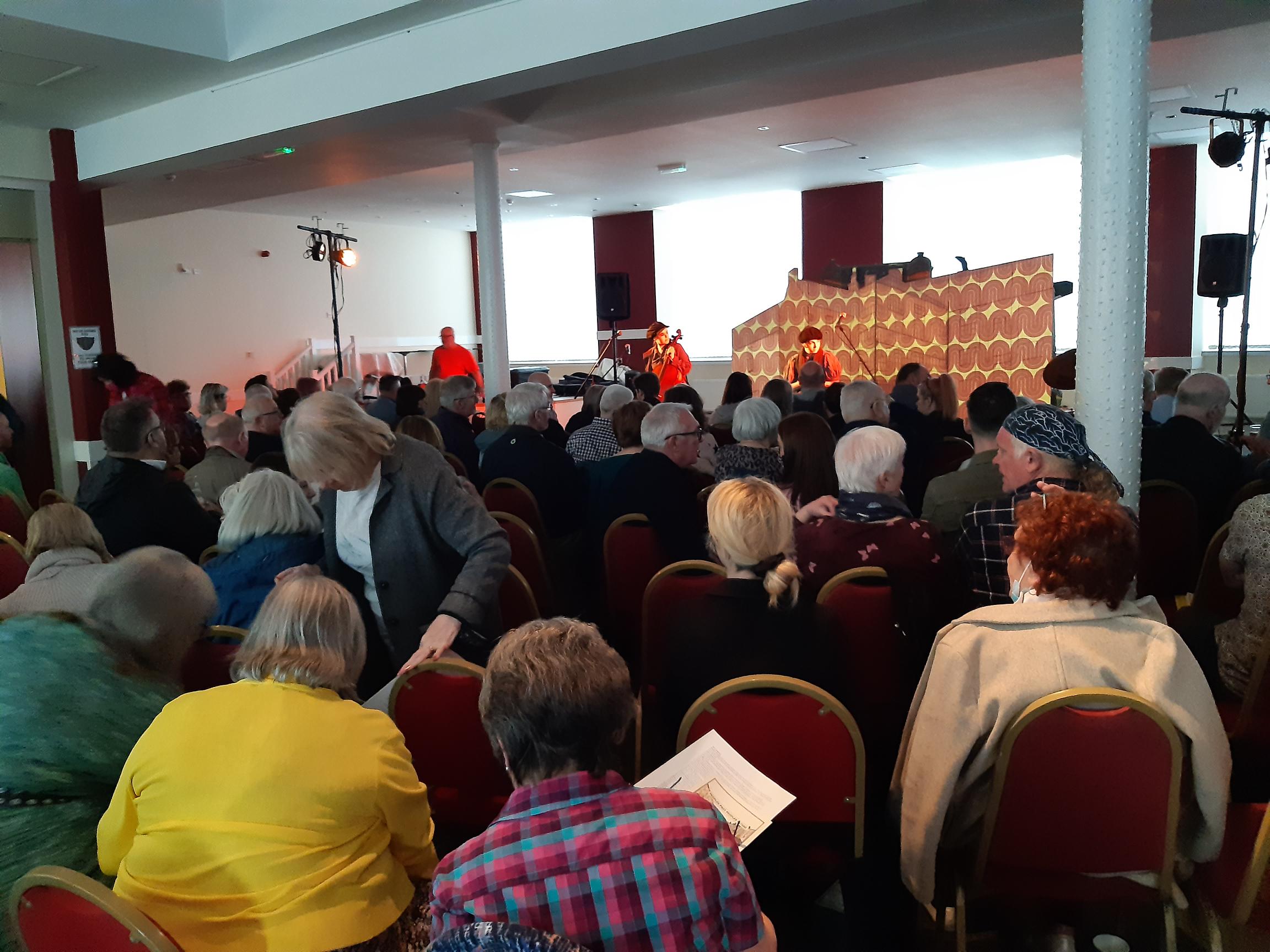
Part of the large, working-class audience in Rutherglen 


Hope Shines Eternal

And hope shines out. Hope based on this accurate account of the real victories of united workers’ struggles 50 years ago, but also hope that new, current generations will reawaken to such methods, as – in Aggie’s words – “the Tories never learn but also never forget nor forgive us.”

After an interval during which the People’s Past People Future organisers kindly laid on ‘a strikers’ supper’ of wholesome soup and rolls, the night was rounded off by songs from Rutherglen Community Choir and a powerful rendition of two of his union songs by 81-year-old socialist singer-songwriter, Arthur Johnston.

Socialism Returns!

And yet it didn’t end there! A big group of the audience – including many of the large numbers who bought my pamphlet Socialism Returns in the 21st Century, as advertised by the organisers during the raffle! – kept me back for nearly an hour discussing why we need the spirit of UCS today, or as a few of them said, “we need a revolution!”

Many of these men and women were scathing about all the political parties – “For the first time in my life I won't vote for any of them" – but readily added they trust our party, the SSP, because they know we are honest and tell it how it is on the side of the working class.

I left this brilliant night thinking: imagine if YES! YES! UCS! was shown on mainstream TV!

Imagine the impact on younger people with little or no knowledge of such glorious periods of working-class struggle. Imagine how it would uplift and embolden workers today, as they face the capitalist thuggery at P&O ferries, fire and rehire, and a multitude of daily assaults on our lives as the profiteers seek to recover and replenish their ill-gotten wealth, at the expense of terrible suffering and privation for millions of workers and their children.

Which is why those in power would not dare televise it! And why it’s so important that others imitate the actions of People's Past People's Future by taking this marvellous, inspiring piece of popular theatre into local communities: to the people with most to gain by rising up in the manner of UCS.

As John Lennon sang in response to the UCS, “Power to the People!”


READ THE BLOG & BUY THE PAMPHLET 

Last August 2021 I wrote an article on the UCS work-in, on the 50th anniversary of one of the mammoth demonstrations through Glasgow in support of the right to work. 
It cannot match the graphic portrayal of musical theatre, but it helps give background reading to the events, and lessons for today. Please have a read of it. 
You will find it here: http://richieventon.blogspot.com/2021/08/ucs-still-inspiration-50-years-on.html


And consider ordering a copy of Socialism Returns in the 21st Century - which sold in large numbers at the People's Past People's Future presentation of YES! YES! UCS! 
Order here: https://scottishsocialistparty.org/product/socialism-returns-in-the-21st-century/


Wednesday, 23 September 2020

DEMAND FULL AVERAGE WAGES FOR ALL SICK WORKERS!


Throughout the pandemic I have argued, both as a socialist and elected trade union convenor, for full average wages for anyone sick or in self-isolation from COVID-19.

My concern, particularly amidst the worst killer pandemic in a century, was that some workers dumped onto £95-a-week Statutory Sick Pay (SSP) would confront the impossible choice of financial ruin or dragging themselves into work, spreading the virus, sickness, even death.

Even where unions have conquered some form of occupational sickness benefit, it is frequently less than normal wages, accumulates sick absence penalty points, and excludes workers from a single penny company sick benefit if their absence points are too high.

And right across the board, employers are busily hacking away at occupational sick benefits, under cover of the Coronavirus crisis. That includes companies whose profits rocket beyond £millions to £billions. 

With household debts at record highs, savings at record lows, and job insecurity looming like a train charging down the track towards millions of workers, they are stressed to breaking point, but have nothing to fall back on; work makes many sick, but they can’t afford to take time off to recover. 

A new volcano of both physical and mental ill-health is set to explode, after months of home-working, cramped housing, and social isolation.

Sickness Unaffordable 

Mine might be the first case of a shop steward in Scotland losing his/her job in a dispute with an employer over workers’ health and safety during the Coronavirus, but it throws a harsh spotlight on the broader, deeper crime in society: sick workers can’t afford to be sick – and that makes them even sicker!

Sick pay in the UK is not only a national, but an international scandal.

Statutory Sick Pay of £95.85 a week is appallingly miserly even by the inadequate standards of Britain’s capitalist competitors.

The European average equivalent is £245 a week.

A worker taken sick in this country is only guaranteed 20% of average wages, whereas across Europe it’s 65%. 

Belgium guarantees sick workers their full salary for 30 days. Germany pays their full salary for 6 weeks and 70% of a worker’s wage for the remainder of sick leave. Norway pays up to 52 weeks full salary if a worker has a long-term illness.

Britain is the worst in the whole of Europe, with the single exception of Malta.

Sick Pay Exclusion Zones 

And it gets worse. The word ‘statutory’ implies everybody is guaranteed that amount. Far from it!

Anyone on less than the Lower Earnings Threshold of £120 a week is disqualified from SSP.  That constitutes a mass army of 1.8 to 2 million workers excluded from even that derisory £95. 

That includes a third of all those on zero-hour contracts; one in 10 women workers; 20% of 16-24-year olds; and over a quarter of those working beyond the age of 65 - in part because of the pathetic state pension.

The UK is one of only four countries which totally excludes the self-employed; a growing proportion of workers. 

And most migrant workers are excluded from even this paltry benefit, relying on literally zero income if they fall sick; many hired by the most unscrupulous profiteers, who habitually ignore health and safety regulations, let alone offer any kind of company sick benefit. 

Britain truly is the sick man of Europe, making working class men and women sick, but depriving them of adequate sick pay.

Greencore Northampton - lack of union makes you sick! 

Fatal Consequences 

The consequences are horrendous at the best of times, but fatal during the pandemic.

A new rash of COVID-19 clusters has erupted in poultry and meat plants, sweatshop garment factories, and at several food production workplaces.

Greencore, who produce Marks and Spencer’s sandwiches, have been at the heart of a scandal at their Northampton branch where 324 of its 834-workforce tested positive for COVID-19.

As Sarah Woolley, the new general secretary of the Bakers union (BFAWU) explained at a recent online rally I was invited to speak at - alongside other workers, Sarah and John McDonnell MP - it’s significant Greencore’s Northampton branch does not recognise the Union. They refused to close as cases multiplied, ignoring workers' concerns. 

When the government eventually forced temporary closure, self-isolating workers were expected to exist on £95. As Sarah explained, many were forced to use food banks, and with many multiple family members working there, entire household incomes vanished overnight. “Hearing people who work for a company that makes £55million in pure profit talking about how their income dropped from £240 to £95 is just horrific. How the hell are they supposed to pay the bills?”

Throughout the lockdown we warned Scotland's care homes were incubators for COVID-19. In part, due to decades of refusal to invest in NHS staff and equipment leading to 1,200 elderly patients being transferred out of hospital wards into care homes to clear bed space, without being tested, or worse still, despite testing positive.

This criminal carnage was added to by care home workers, almost universally denied any occupational sick benefit, being terrified of self-isolating, with their already-low incomes slashed to £95 SSP. 


Bakers' Union at TUC 

The Bakers’ Union initiated a Motion at the TUC congress calling for full wages for sick workers for 6 weeks, paid directly by the employer, and increased Statutory Sick Pay thereafter. 

Alongside the struggle for a vastly enhanced minimum wage for all over 16 - at least £12 an hour - the battle for full 100% average wages for all sick workers - whether with COVID-19 or anything else - is critical. Central to a future that puts workers’ health and lives miles ahead of the wealth and privileges of profiteering capitalist employers and their hired enforcers in the boardrooms and senior management. 

Workers' Control of H&S 

The lived experiences of millions during the pandemic has also reinforced the urgency of the Scottish Socialist Party's demand for workers’ control of health and safety, through elected committees of union health and safety reps and shop stewards.

Many of the hazards at work, physical and mental, could be removed and prevented by workers’ representatives whose everyday experiences put them far more in tune with workplace risks than the depleted, downgraded Health and Safety Executive Inspectors, whose numbers have been halved. And who are now to be replaced by undertrained substitutes, with less powers, from privatised outsourcing companies. 

No wonder only 38% of workers reported in this week's BritainThinks Survey that their employers carried out a COVID-secure risk assessment, and only a similar 42% have been given adequate PPE.

A system run for private profit will always cast workers' health to the back of the queue, and when capitalist profiteering triggers illness through stress, insecurity, poverty and shoddy safety standards, sick workers are tossed aside like squeezed lemons. 

The potential power of the organised trade union movement needs to be urgently mobilised to put workers’ health before capitalists' wealth. 

Full, 100% average wages for all sick workers, and control of workplace safety by elected union representatives, are two of the measures which must be pursued by our side with the same determination as bosses chase after shortcuts to profit. 

Workers’ lives before profit must be turned from a phrase into a fight. 

..........................


This blog has also been published in the online Scottish Socialist Voice

I would encourage you to take out a subscription for this excellent fortnightly online publication, which covers key issues at home and abroad from a working class and socialist perspective. 

For only £10 you get 12 separate issues directly to your email Inbox. 

The link to subscribe is:  https://socialistvoice.scot/subscriptions/


Wednesday, 30 January 2019

FIGHT TO SAVE EVERY TESCO JOB!


Retail giant unilaterally declares 9,000 job losses 


Tesco workers have reacted with a mixture of shock, anxiety and fury at the announcement of 9,000 job losses, and the manner in which this jobs slaughter was declared.

In what was undoubtedly a cynically calculated leak from the higher echelons of Tesco's bosses, the weekend press was full of speculation about 15,000 job losses. If they thought this would lead to a collective sigh of relief from thousands of distressed workers when the official announcement of ‘only’ 9,000 job losses was subsequently made, they were badly mistaken. Workers are rightly furious at Tesco bosses treating them, and their unions, with such utter, high-handed contempt.

An unprecedented number of retail workers are talking about the case for industrial action to stop these job losses. Unless talks with Tesco produce an acceptable, total retreat from these plans - protecting all jobs, wages and conditions - union activists and members in general are going to have to seize the bull by the horns and make it plain that they are indeed prepared for collective action. Otherwise, unless serious resistance is mounted, three times as many jobs as were infamously wiped out at the Lanarkshire Ravenscraig steelworks could be decimated.

TESCO RIP UP PARTNERSHIP AGREEMENT


What does this grotty episode say for Tesco’s attitude to the oft-trumpeted partnership agreement with Usdaw?

They've arrogantly ripped this agreement to shreds, not even consulting the union, let alone negotiating their plans. Instead, unilaterally declaring their savagery via the media, proving in action that they believe in the dictatorship of big business over workers and their elected representatives.

Even the pathetically weak employment laws in this business-dominated state prescribe consultation – and meaningful consultation at that – at the formative stage of any planned changes to a business. This plan of butchery is in flagrant contradiction to that procedure, let alone the alleged partnership agreement Tesco’s signed up to with Usdaw.

As I've often written before, social partnership is the partnership of the rider and the horse, with big business in the saddle.


Tesco bosses plan to slash 9,000 jobs, closing fresh food counters in 90 of their 790 large stores. They also want to only open the meat, fish and deli counters part-time in the other 700 stores, plus cut back on staffing levels in the replenishment and layout design operations. To add insult to injury, they aim to replace staff canteens with glorified vending machines. That in itself means loss of jobs for canteen staff. And when worries about the future of their bakeries are raised, they trot out those well-worn, weasel words, “we have no plans to shut the bakeries”; aye, no plans now, but what about the next phase of cuts, if they get away with this round?


HOW IS ENDING FRESH FOOD COUNTERS ‘SUSTAINABLE’?


What does this plan do for the growing, modern demand for fresh, locally-sourced food? How does that match their soothing words about merely wanting “a simpler, more sustainable business”? In truth, it’s just the latest link in the chain of strangulation of small businesses, small farmers and food producers which the big supermarkets wield every time they move into a town or area. For instance, they wipe out local butchers’ shops and fishmongers, and now plan to get rid of fresh fish and meat counters in their own super-stores.

Of course, the immediate task of the union is to challenge Tesco’s bogus claims, and demand that there is not a single job loss, nor a penny lost in any worker’s pay, in any changes to roles in the stores that might be (belatedly!) negotiated with the unions – where Usdaw itself represents over 160,000 Tesco workers. And every store should have a proper staff canteen – not to mention protection and expansion of fresh food counters, sourced locally.


TESCO’S SKYROCKETING PROFITS


What possible justification can there be for this jobs brutality? 
Workers’ efforts have achieved 12 consecutive quarters of growth for the business, plus a successful Christmas trading period.

And this is no struggling family corner shop!

Tesco’s profits have skyrocketed in recent years, after top bosses incurred a loss of £2billion in share values by, putting it plainly, fiddling the books. Profits rose from £145m the previous year to £1.3billion in 2017, a gargantuan 800% increase. And this bounty rocketed by a further 28% last year, to £1.64billion.

In the UK and Ireland alone, the efforts of Tesco workers produced over £1.1billion in profits last year - another 31% rise on the year before.

Where have all the profits gone? That's one of the central questions workers and the union need to pursue and expose, in fighting to rip apart Tesco’s so-called business case for this butchery of jobs and conditions. They should be forced to open up their company plans and balance sheets to public inspection by the unions and financial experts. What have they got to hide, if they are merely wanting to meet changing customer expectations and “building a simpler, more sustainable business”, as they claim?

DEMAND A LEGAL MAXIMUM INCOME 


We already have a partial answer to the question of where the profits sweated from workers have gone: the bank accounts of top Tesco bosses. Chief Executive,  ‘Drastic’ Dave Lewis, enjoyed an increase of 17.5% on his income last year, to a staggering £4.9million. 
Leaving aside the combined incomes of the other directors, Lewis’s obscene greed alone justifies the policy which I successfully proposed at the 2018 Usdaw national conference (ADM) - for a Legal Maximum Income initially set at ten times the legal minimum wage. 
If that was applied to the Tesco CEO, imagine the impact of ploughing over £4.7m back into workers’ wages and job security, instead of it going into the coffers of one fat-cat.


LOW PAY AND INSECURE CONTRACTS THREATEN JOBS


Retail in general is in crisis, with multiple causes. Last year, 70,000 jobs were shed, and the British Retail Consortium forecasts a further 90,000 job losses this year. 
One of the root causes of the terrible insecurity and loss of conditions facing the 3 million workers in retail is the chronic low pay and insecure contracts imposed by the profiteers on this vital sector of the economy - which contributes at least 11% of GDP.

Low wages and low hours – zero-hours and, more commonly, short-hours contracts – strangle workers’ spending power, and thereby threaten jobs. And it's not just poverty pay in retail that causes this problem; it's a plague across all sectors.

That's why Usdaw’s centre-piece Time For Better Pay campaign is so critically important.  The demands for an immediate £10-an-hour minimum wage for all workers, and a guaranteed minimum 16-hour contract for every worker who wants it, would help fuel the economy, boost workers’ spending power and their sense of security. And it would substantially redistribute wealth from profits to pay.

Likewise, Usdaw’s campaign for a Retail Industrial Strategy is critical in resisting this jobs slaughter, highlighted by the Tesco announcement, but common to all the Big 4 supermarkets and the rest of the sector.  This calls for measures including changes to taxation to end the unfair advantages enjoyed by online traders over ‘bricks and mortar’ stores; reform of local commercial rents, business rates, public transport and car-parking, to help save our High Streets; investment in upskilling retail workers to meet the challenges of new technology; and improved productivity through decent pay and contracts.


DEMOCRATIC PUBLIC OWNERSHIP OF RETAIL GIANTS

But in my personal opinion, the outrageous butchery declared by the unelected, totally unaccountable profiteers also highlights the need for a radical overhaul of who owns and controls retail. 
Why should multi-millionaire owners and Chief Executives have the power to destroy the livelihoods of thousands of workers, and create havoc for entire families and communities?

Why should they be entitled to cream off £billions in profit and then ‘reward’ those workers who created this mountain of wealth for them with a P45?  
At the 2017 Usdaw national conference it was agreed to call for public ownership in such situations. That would lay the foundations for a democratic plan of action - embracing retail workers’ union representatives, local authorities and governments - to invest in town centres and other retail outlets in a fashion that maximises jobs, retail services to communities, and indeed the interests of family farmers and small businesses. 
A retail sector based on public needs and agreed priorities, rather than dictatorship by the retail giants; an end to the rule of private profit for the few over the lives and livelihoods of millions of people.